The practical metal-worker's assistant : comprising metallurgic chemistry, the arts of working all metals and alloys, forging of iron and steel, hardening and tempering, melting and mixing, casting and founding, works in sheet metal, the processes dependent on the ductility of the metals, soldering, and the most improved processes, and tools employed by metal-workers, with the application of the art of electro-metallurgy to manufacturing processes, collected from original sources, and from the works of Holtzapffel, Bergeron, Leupold, Plumier, Napier, Scoffern, Clay, Fairbairn, and others (1872)
Byrne, Oliver · Philadelphia : H.C. Baird · leaf 310
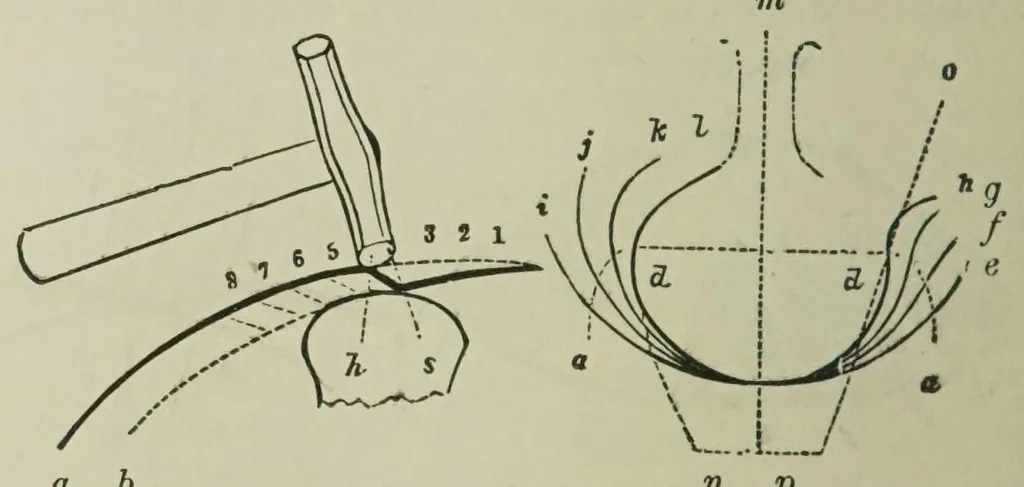
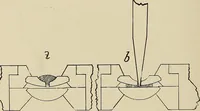
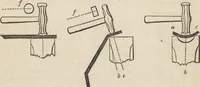
be annealed. Figs. 261 and 262 explain the transition or conversion from the first sweep a, to the second sweep b ; the black lines represent the metal after a circles of blows have been given. Fig. 262 shows the narrow edge of the raising-hammer, in the act of descending upon the centre of the… … a b n p larly gathered in, then 3, 4, 5, and so on, up to the edge. Now the artifice consists in making the intervals both of the great sweeps, a, b, c, Fig. 259, and of the little waves 1, 2, 3, of Fig. 262, as large as practicable, provided they do not cause the exterior metal to pucker or become…
Metal-work · Electrometallurgy · Metallurgy
Internet Archive · Getty Research Institute · Public domain (published before 1931). Free to use for anything.